Virtual Science Club (VSC) will begin on September 9, 2025 and continue through March 3, 2026. VSC usually meets on the first and third Tuesdays of the month at 7:00PM EDT.
VSC provides free programming to assist students and teachers in developing STEM skills and to motivate students to enter the upcoming Southern Appalachian Science & Engineering Fair (SASEF), which will be held in person on the University of Tennessee, Knoxville campus on March 24, 2026.
Students and teachers from any region are welcome!
Sessions & Recordings
- The Virtual Science Club
- The Southern Appalachian Science & Engineering Fair
- How to structure a STEM project
- Go into breakout rooms by research area to meet your UTK graduate student mentor that will be hosting sessions monthly through January. The four research areas to choose from are:
- Human Sciences
- Behavioral & Social Sciences
- Medicine & Health Sciences
- Natural Sciences
- Animal Sciences
- Biochemistry
- Cellular & Molecular Biology
- Environmental Sciences
- Microbiology
- Plant Sciences
- Machine Learning & Emerging Technologies
- Artificial Intelligence
- Machine Learning and Algorithms
- Technological Advancement
- Engineering & Math
- Computer Science
- Engineering: Electrical & Mechanical
- Engineering: Materials & Bioengineering
- Energy & Transportation
- Mathematical Sciences
Session Description: In this session, Dr. Nickels will present on the impact of his SASEF participation in addition to his journey to his current career and research endeavors.
Speaker’s Bio: Jonathan D. Nickels is an Associate Professor of Chemical Engineering at the University of Cincinnati. A graduate of Knoxville Catholic High School (Class of 2000), Jonathan was a two-time participant in the Southern Appalachian Science and Engineering Fair (SASEF): runner-up in the group category in 1999–2000 and champion in the individual category in 1998–1999. His winning project examined correlations between reported parental income, parental educational attainment, and blood-sugar control metrics in juvenile diabetics from the East Tennessee area. Jonathan has maintained his commitment to science fairs by volunteering as a judge for the Cincinnati area and Ohio statewide science fairs.
Following graduation from KCHS, Jonathan attended the University of Notre Dame, earning a degree in Chemical Engineering in 2004. He went on to receive his Ph.D. in Chemical Engineering from the University of Texas at Austin. Afterward, he served as a postdoctoral researcher at Oak Ridge National Laboratory before joining the University of Cincinnati as a faculty member, where he now holds the rank of Associate Professor.
At Cincinnati, Jonathan leads a research group supported by the National Science Foundation, the U.S. Department of Energy, the American Chemical Society, and Procter & Gamble. His work focuses on soft-matter physics, biofuel production, and molecular transport, and it maintains strong ties to his East Tennessee roots through collaborations with the world-class scientific infrastructure at Oak Ridge National Laboratory.
Session Recording:
Session Description: Go into breakout rooms by research area to discuss your plans for your 2026 SASEF STEM project. Bring any and all questions you may have!
Session Recording:
Session Description: In this session, John will highlight a wide range of opportunities within health and medicine, as well as non-traditional career paths that intersect with technology and related fields.
Speaker’s Bio: John S. Jeffries is the Information Security Director at the University of Tennessee Medical Center, where he oversees IT risk strategy and created a cyber internship program to train future security professionals. A retired U.S. Navy veteran with 23 years of service—including participation in Operation Desert Shield/Storm and Operation Enduring Freedom/Iraqi Freedom—he held top-secret clearance and led training and performance management for service members. Active in the cybersecurity community, John is a Knoxville FBI Citizens Academy graduate, volunteers with local colleges, supports the East Tennessee ISSA chapter, and is a member of InfraGard’s Knoxville Chapter.
Session Recording:
Session Description: Go into breakout rooms by research area to discuss your plans for your 2025 SASEF STEM project. Bring any and all questions you may have!
Session Recording:
Speaker’s Bio: During this session, Dr. Staples wants YOU to imagine yourself as a game designer in connecting your everyday lives to this game!
This meeting will be the foundation of Dr. Staples teaching and research philosophy where results revealed how game design fosters deeper understanding and creativity. Inspired by this, she founded The APP.FARM to support students and faculty in creating innovative, meaningful, and interdisciplinary learning experiences.
Session Recording:
Speaker’s Bio: Dr. Kimberly D. Gwinn is a Professor in the Department of Entomology and Plant Pathology at the University of Tennessee who investigates the influence of natural products in One Health systems. The overall goal of her research is to uncover the origins, functions, and ecological roles of natural compounds that mediate interactions both within and between organisms. Dr. Gwinn teaches courses on the use of plant and microbial products as medicines and on their use as biopesticides. Throughout her career, she has supported STEM education at all levels. She is an avid proponent of undergraduate research and is nationally recognized for research investigating the role of undergraduate research in STEM development. Her research program has served as a foundation more than 80 undergraduate research projects. She is active in community STEM outreach and serves as Fair Director for the Southern Appalachian Science and Engineering Fair. Dr. Gwinn is a founding member of the Virtual Science Club.
Session Recording:
Session Description: Go into breakout rooms by research area to discuss your plans for your 2025 SASEF STEM project. Bring any and all questions you may have!
Session Description: Go into breakout rooms by research area to discuss your plans for your 2025 SASEF STEM project. Bring any and all questions you may have!
Session Description: TBA
SASEF Categories – What breakout session to attend?
One meeting per month will feature smaller “breakout” sessions separated into the following four research areas. Each research area’s breakout room will have mentors including a UT graduate student, at least one science and engineering professional, and at least one SASEF board member. These mentors will assist students with questions about STEM activities particularly focusing on those activities that will support a SASEF project.
- Human Sciences
- Behavioral & Social Sciences
- Medicine & Health Sciences
- Natural Sciences
- Animal Sciences
- Biochemistry
- Cellular & Molecular Biology
- Environmental Sciences
- Microbiology
- Plant Sciences
- Machine Learning & Emerging Technologies
- Artificial Intelligence
- Machine learning and Algorithms
- Technological Advancements
- Engineering & Math
- Computer Science
- Engineering: Electrical & Mechanical
- Engineering: Materials & Bioengineering
- Energy & Transportation
- Mathematical Sciences
Meet The Research Area Mentors
Holly Brabazon, Natural Sciences Mentor
 Holly Brabazon is currently a PhD student at the University of Tennessee in the Entomology and Plant Pathology Department. She is studying the genetics of the cocoa tree, Theobroma cacao and is working to discover genetic diversity found in wild cacao populations. Her research interests involve using genomic tools to discover and conserve biodiversity. Her previous research includes creating plant “phytosensors” that detect radiation and researching how plants respond to human decomposition.
Machine Learning and Emerging Technology
Andrew Wood, Engineering & Math Mentor
 Andrew Wood is a third-year Ph.D. student in Civil and Environmental Engineering under the advisement of Dr. Dayakar Penumadu. His research focuses on the mechanical characterization of additively manufactured materials under extreme environment conditions -at multi-scale/temperature conditions. Originally from Colorado, loves the outdoors and to ski and mentoring students to explore and love STEM fields.
Alina Rosati, Human Sciences Mentor
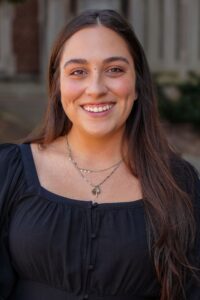 Alina Rosati is originally from Loudon, TN, and did her undergraduate degree at Maryville College. She is currently a master’s student in the UT Philosophy department and is mainly interested in the relationship between cellphone use and commonsense reasoning. She also has an interest in the role of meaning in our daily thinking and how a sense of meaning contributes to our ability to form healthy social relationships. Outside of school she spend most of her time feeding her pickleball addiction and training her German Shepard.